
Pipeline growth now depends on timing, account visibility, buyer signals, and stronger qualification workflows. Pushing larger lead volumes into outbound campaigns does not work like it used to. Modern revenue intelligence platforms help sales teams identify warmer opportunities, prioritize accounts, analyze engagement behavior, and improve forecasting accuracy before deals move deeper into the pipeline.
GTM teams increasingly combine scoring models, enrichment layers, account tracking, and product signals during pipeline management. Different platforms solve different operational bottlenecks across the revenue cycle. The platforms below approach revenue intelligence from very different angles.
Some revenue intelligence tools focus on manually reviewed outbound data. Others prioritize champion tracking, predictive scoring, lookalike targeting, inbound qualification, forecasting, or product-led engagement signals. Modern revenue operations rarely depend on one isolated workflow anymore. Stronger pipeline visibility improves prioritization decisions across both sales and marketing teams. Here is a quick positioning summary:
- Emarketnow focuses on manually reviewed outbound prospecting data for targeted campaigns.
- UserGems specializes in champion tracking and job-change intelligence workflows.
- Ocean.io provides AI-driven lookalike account discovery for outbound targeting.
- MadKudu focuses on predictive lead scoring and revenue prioritization.
- RevSure delivers forecasting visibility and revenue pipeline intelligence.
- Default automates inbound qualification and lead routing workflows.
- Pocus supports product-led sales intelligence and user engagement tracking.
Every platform below contributes different forms of pipeline intelligence depending on sales structure, qualification complexity, and outbound strategy. Let us dive in.
1. Emarketnow
A manually reviewed outbound prospecting data platform.

Emarketnow’s revenue intelligence platform focuses on manually reviewed outbound data for targeted sales campaigns. Businesses can build prospect lists using filters like industry, company size, revenue, location, and job titles. The platform prioritizes cleaner segmentation and fresher contact records instead of automated scraping systems. Stricter filtering standards reduce irrelevant outreach activity during outbound campaigns. No automated junk here.
Emarketnow emphasizes validation workflows and prospect relevance before records get delivered. Tighter segmentation improves outbound precision and reduces wasted prospecting effort during pipeline generation. Manually reviewed data helps teams avoid weaker-quality contact exports common in larger databases. The platform focuses more on targeting accuracy than sheer contact volume. Key outbound targeting strengths include:
- Human-reviewed B2B prospecting data;
- Double-validated work emails and mobile numbers;
- ICP-focused segmentation workflows;
- Industry-specific targeting support;
- U.S.-focused outbound prospecting.
Emarketnow works especially well for businesses prioritizing cleaner targeting and more controlled outbound workflows.
Strongest Revenue Fit
Emarketnow fits outbound teams that value relevance, cleaner segmentation, and manually reviewed prospecting data over massive contact exports. Precision beats volume.
2. UserGems
A champion tracking and relationship intelligence platform.
UserGems focuses on identifying job changes and tracking customer champions across companies. Sales teams use the platform to reconnect with former buyers or users who move into new organizations. Relationship continuity creates warmer outbound opportunities and shortens prospecting cycles. UserGems approaches revenue intelligence through relationship tracking instead of traditional lead sourcing.
UserGems helps teams surface pipeline opportunities based on existing customer relationships and professional movement signals. Outbound timing improves when teams identify familiar decision-makers entering new roles. Relationship-based prospecting strengthens conversion efficiency compared to colder outreach strategies. The platform focuses heavily on account continuity and sales timing. Key relationship intelligence features include:
- Job-change monitoring;
- Champion tracking workflows;
- Relationship-based prospecting;
- Account continuity insights;
- Pipeline opportunity alerts.
UserGems fits businesses relying heavily on relationship-driven outbound strategies and customer expansion workflows.
Best Relationship Use Case
UserGems works especially well for teams prioritizing warm introductions and account continuity during pipeline growth efforts. Old relationships, new opportunities.
3. Ocean.io
An AI-driven lookalike account targeting platform.
Ocean.io focuses on finding companies that resemble existing customers using AI-based modeling and account analysis. Businesses use the platform to expand outbound targeting beyond manually selected prospect lists. Lookalike modeling helps teams discover accounts with stronger similarity to proven customers. Ocean.io emphasizes account matching and targeting precision over broader contact exports.
Ocean.io helps outbound teams improve account discovery through similarity-based prospect research. AI-driven targeting uncovers opportunities traditional filtering may miss. Stronger account matching improves outbound efficiency and pipeline quality over time. The platform centers heavily on scalable account identification workflows. Key account discovery features include:
- AI-driven lookalike targeting;
- Similarity-based account discovery;
- Scalable prospect research;
- Customer profile matching;
- Outbound account expansion.
Ocean.io fits outbound teams wanting stronger account discovery and broader targeting visibility during prospecting.
Ideal Targeting Environment
Ocean.io works best for teams scaling outbound campaigns through AI-assisted account matching and lookalike discovery. Find more companies like your best customers.
4. MadKudu
A predictive scoring and revenue prioritization platform.
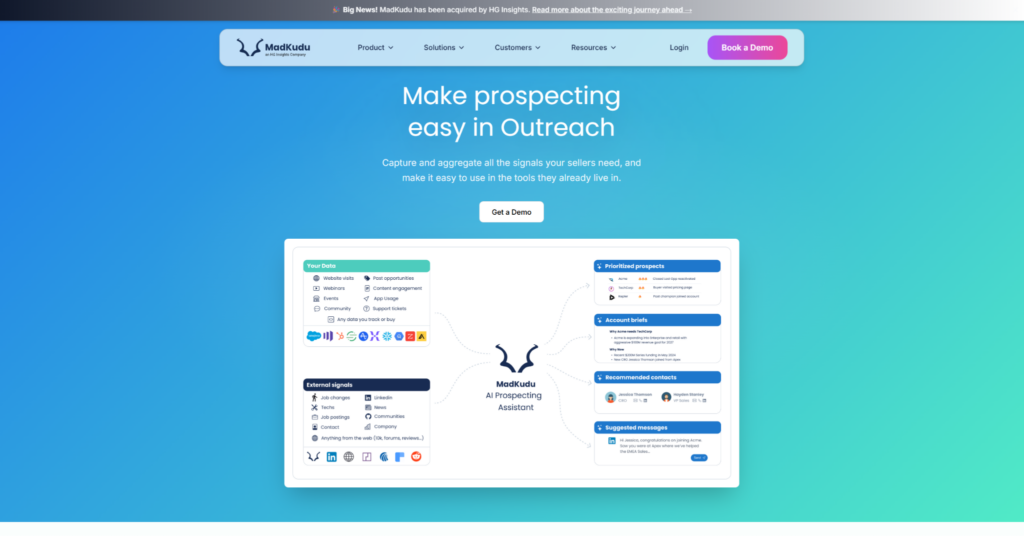
MadKudu focuses on predictive lead scoring and pipeline prioritization for GTM teams. Businesses use the platform to analyze behavioral signals and rank opportunities based on conversion potential. Predictive scoring helps sales teams focus on accounts with stronger revenue likelihood. MadKudu approaches revenue intelligence through scoring models and signal analysis rather than contact sourcing.
MadKudu helps teams reduce wasted outbound effort by improving prioritization accuracy during active campaigns. Stronger lead scoring influences outreach timing and qualification workflows. Predictive insights improve efficiency across larger pipeline environments. The platform focuses heavily on revenue prioritization and forecasting support. Key predictive intelligence features include:
- Predictive lead scoring;
- Revenue prioritization workflows;
- Behavioral signal analysis;
- Qualification optimization;
- Pipeline scoring visibility.
MadKudu fits businesses wanting stronger prioritization systems and predictive qualification workflows.
Best Pipeline Scenario
MadKudu works especially well for teams prioritizing scoring accuracy and smarter pipeline allocation during outbound campaigns. Work on the right leads first.
5. RevSure
A revenue forecasting and pipeline visibility platform.
RevSure focuses on forecasting visibility, pipeline tracking, and revenue analytics for GTM teams. Businesses use the platform to monitor deal progression and improve forecasting consistency across sales operations. Stronger pipeline visibility supports smarter planning and revenue management decisions. RevSure emphasizes forecasting intelligence instead of traditional prospect research.
RevSure helps teams monitor pipeline health and identify operational gaps affecting forecast accuracy. Forecasting visibility improves decision-making across both sales leadership and revenue operations teams. Pipeline analytics create more structured revenue planning workflows. The platform centers heavily on revenue forecasting and operational clarity. Key forecasting features include:
- Pipeline visibility workflows;
- Forecasting analytics support;
- Revenue tracking insights;
- Deal progression monitoring;
- Sales operations reporting.
RevSure fits organizations prioritizing forecasting clarity and stronger revenue visibility across larger sales operations.
Recommended Revenue Setup
RevSure works best for businesses needing deeper forecasting visibility and more structured revenue planning workflows. Know what is coming down the pipe.
6. Default
An inbound qualification and lead routing platform.
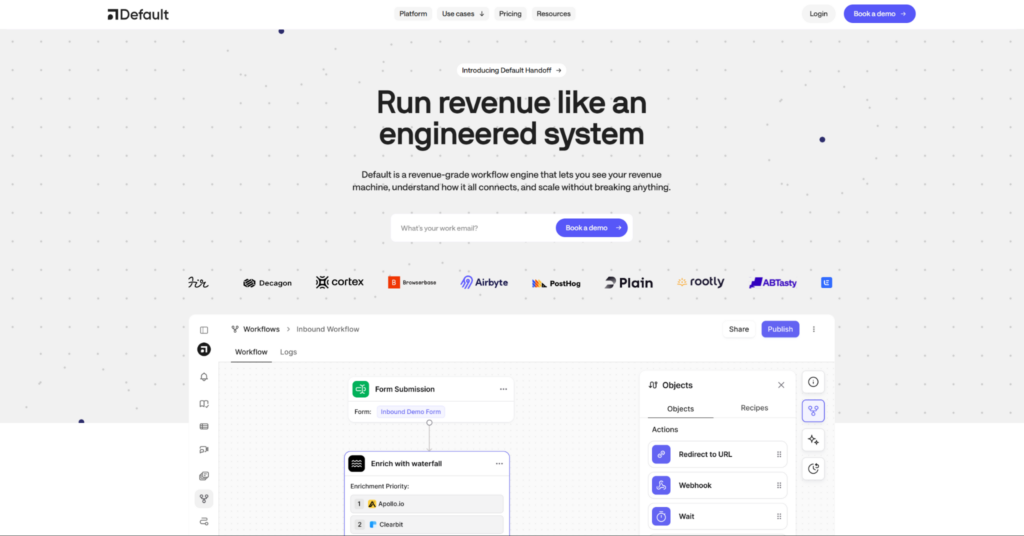
Default focuses on automating inbound qualification and routing workflows for GTM teams. Businesses use the platform to qualify inbound leads faster and improve response efficiency during pipeline generation. Qualification automation reduces delays and improves handoff consistency between teams. Default prioritizes operational speed and workflow structure during inbound management.
Default helps teams streamline inbound qualification before leads enter deeper sales workflows. Faster routing and qualification improve conversion timing during high-volume campaigns. Operational automation reduces friction across inbound pipelines. The platform focuses heavily on qualification efficiency and workflow organization. Key qualification workflow features include:
- Inbound qualification automation;
- Lead routing workflows;
- Faster response management;
- Qualification process visibility;
- Workflow efficiency support.
Default fits businesses prioritizing faster inbound handling and more structured qualification operations.
Most Practical Workflow Fit
Default works especially well for teams managing higher inbound lead volumes and qualification-heavy workflows. Speed and structure matter here.
7. Pocus
A product-led sales intelligence platform.
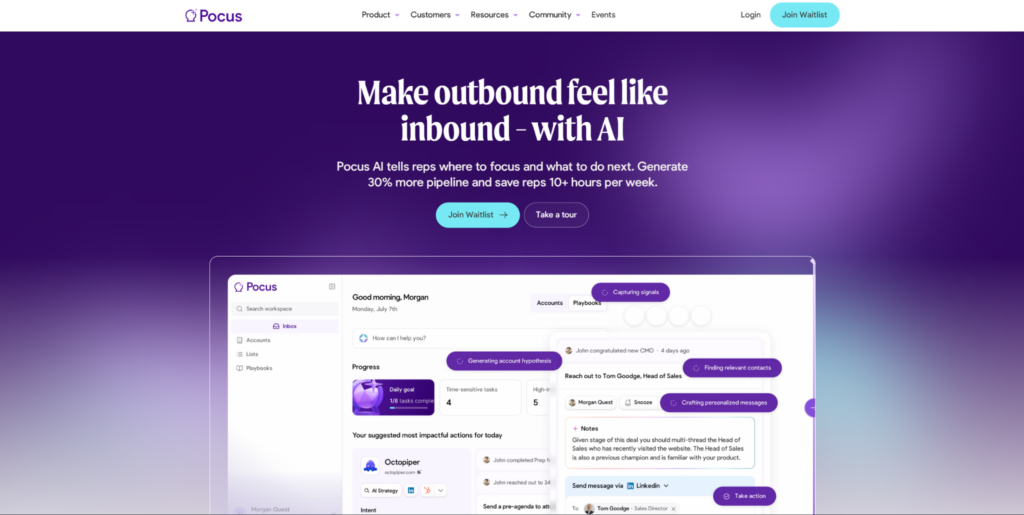
Pocus focuses on product usage signals and account engagement visibility for sales teams. Businesses use the platform to monitor user activity, identify expansion opportunities, and prioritize accounts based on product engagement. Product-led signals improve account prioritization during outbound workflows. Pocus approaches revenue intelligence through product interaction data instead of static lead sourcing.
Pocus helps teams identify accounts showing stronger engagement inside product environments before direct sales conversations begin. Usage visibility improves expansion timing and outbound efficiency. Product-level signals create stronger context during account prioritization. The platform focuses heavily on PLG workflows and account engagement visibility. Key product signal features include:
- Product engagement tracking;
- Expansion opportunity visibility;
- PLG account prioritization;
- Usage-based outbound signals;
- Product intelligence workflows.
Pocus fits businesses relying on product-led growth signals and usage visibility during pipeline expansion.
Strongest PLG Scenario
Pocus works especially well for teams prioritizing product engagement visibility and expansion-focused revenue workflows. Let product usage guide your outreach.
Revenue Intelligence Strategies That Match Different GTM Models
Different revenue intelligence platforms support very different sales motions. Pipeline structure, qualification complexity, and account targeting strategy all factor in. Some teams prioritize forecasting visibility. Others focus more heavily on relationship tracking, product engagement, or predictive scoring. Modern GTM operations increasingly combine several intelligence layers instead of relying on isolated workflows. Workflow alignment matters more than feature volume during platform selection. Let us wrap this up.
Final Thoughts
Modern revenue intelligence depends on stronger visibility into account activity, qualification workflows, engagement signals, and forecasting layers before deals progress deeper into the pipeline. Different platforms solve different operational bottlenecks across the revenue cycle. Stronger prioritization improves pipeline efficiency more than simply increasing lead volume.
Evaluate revenue intelligence platforms based on workflow compatibility, operational structure, prioritization needs, and revenue strategy. Different intelligence layers support different GTM motions depending on outbound complexity and sales maturity. Stronger workflow alignment improves qualification consistency and pipeline efficiency over time. Focus on smarter prioritization and stronger revenue execution. That is how you win.